
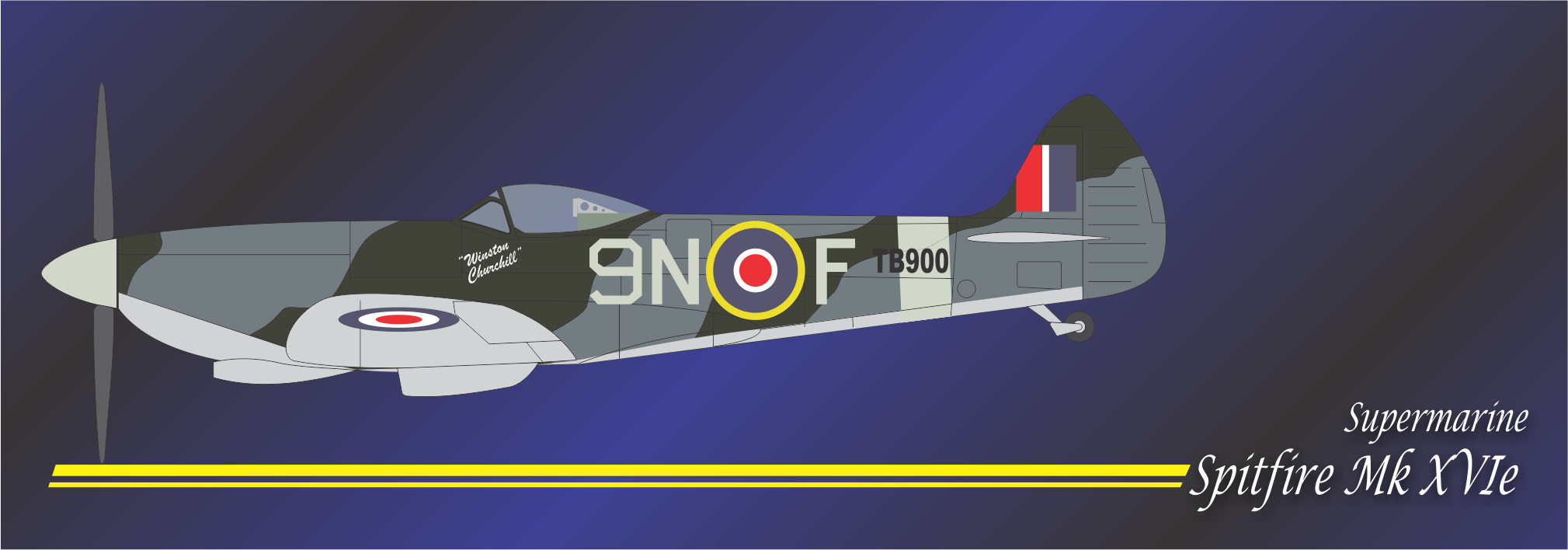
We’re planning a 1/5 scale model of this beautiful WWII fighter. Unusual in having the cut down rear fuselage, the Mark XVIe was, at its heart, a Mark VIII, but with the added looks of that clipped wing.
We know that it isn’t everybody’s cup of tea, but there are lots of plans out there for the more classic Mark V and Mark IX. We wanted something a little different.
Spanning 80 inches, this model will be powered by a 1.6 c.i. nitro engine, or the equivalent gas or electric. It would even support a sound system if you want that authentic Merlin sound…
Laser-cut short kits are not yet available. Just email us for details.
Supermarine Spitfire LF Mk XVIe – Design, Development, Production and Performance
The Supermarine Spitfire LF Mk XVIe was one of the final and most refined Merlin-powered versions of the legendary Spitfire fighter. Developed during the closing stages of the Second World War, it combined the proven Spitfire Mk IX airframe with the American-built Packard Merlin 266 engine, improved low-altitude performance, the new Type E wing, and late-war aerodynamic refinements including the cut-down rear fuselage and bubble canopy.
Although visually similar to the Mk IX, the Mk XVI represented a distinct production variant optimised primarily for low-level fighter and fighter-bomber operations during the final campaigns in Europe. A total of 1,054 Spitfire Mk XVI aircraft were produced, with production continuing until August 1945.
Origins and Development
The Need for a Low-Level Spitfire
By 1943–44, the Luftwaffe threat had changed significantly. High-altitude interception against bombers was becoming less dominant, while Allied air forces increasingly required fighters capable of:
- low-level ground attack
- battlefield support
- escorting tactical bombers
- attacking V-1 launch sites
- armed reconnaissance
The existing Spitfire Mk IX was highly successful, but Supermarine and the RAF sought further improvements:
- improved low-altitude power
- greater firepower
- improved pilot visibility
- better roll performance
- easier production
The solution was the Spitfire Mk XVI, essentially a Mk IX airframe adapted for the Packard-built Merlin 266 engine.
Design Background
The Spitfire Mk XVI originated from the successful Spitfire Mk IX, which itself had been developed as an urgent response to the appearance of the German Focke-Wulf Fw 190A in 1941.
The Mk IX introduced:
- Rolls-Royce Merlin 61/63 series engines
- two-stage, two-speed supercharging
- improved high-altitude performance
- strengthened airframe
The Mk XVI retained the Mk IX structure but incorporated:
- Packard Merlin 266 engine
- revised engine installation
- Type E wing
- clipped wingtips on most examples
- enlarged rudder
- improved cockpit visibility
Powerplant – Packard Merlin 266
The defining feature of the Mk XVI was its engine.
Engine
Packard Merlin 266
(US licence-built version of the Rolls-Royce Merlin 66)
Specifications:
- 12-cylinder, liquid-cooled V12
- two-stage, two-speed supercharger
- approximately 1,580 hp
- optimised for low and medium altitude
The Packard engine differed from British-built Merlins mainly in manufacturing methods and dimensions rather than basic performance. Packard’s ability to produce Merlin engines in large numbers helped free Rolls-Royce production capacity for other aircraft programmes.
Low-Level Fighter Optimisation
The Mk XVI was designated:
LF Mk XVI
where LF meant:
Low Fighter
This did not mean the aircraft was limited to low altitude, but indicated that the engine’s supercharger gearing was optimised for lower operational heights.
The engine produced its best performance below approximately:
- 20,000 ft
This matched the RAF’s increasing requirement for tactical ground-support missions.
Airframe Design
Fuselage
The Mk XVI retained the classic Spitfire semi-monocoque fuselage.
Construction:
- aluminium alloy stressed skin
- light alloy frames
- longerons and stringers
- fabric-covered control surfaces
The elliptical fuselage provided:
- low aerodynamic drag
- excellent strength-to-weight ratio
- smooth airflow
Cut-Down Rear Fuselage and Bubble Canopy
Late-production Mk XVIs introduced:
- lowered rear fuselage
- teardrop-shaped sliding canopy
Advantages:
- greatly improved rear visibility
- easier formation flying
- improved combat awareness
This became one of the most recognisable features of late Spitfires.
Not all Mk XVI aircraft had the bubble canopy; early production aircraft retained the traditional high-backed cockpit.
Wing Design
The Mk XVIe used the Type E wing.
This was a major improvement over earlier Spitfire wings.
Type E Armament Arrangement
The wing allowed:
- 2 × 20 mm Hispano cannon
- 2 × .50 calibre Browning machine guns
This replaced the earlier:
- 2 cannon
- 4 × .303 Browning configuration
Advantages:
- increased destructive power
- improved effectiveness against armoured targets
- reduced ammunition weight
Clipped Wing Modification
Most LF Mk XVI aircraft were fitted with clipped wingtips.
Standard Spitfire wings were shortened by removing the elliptical tips.
Advantages:
- increased roll rate
- improved low-altitude manoeuvrability
- reduced drag at lower speeds
- improved acceleration
Disadvantages:
- reduced high-altitude performance
- slightly increased stall speed
The clipped wing was particularly useful in low-level combat where rapid manoeuvring was more important than maximum altitude capability.
Tail Unit
Late Spitfire Mk XVIs incorporated:
- larger pointed rudder
- improved fin shape
Benefits:
- improved directional control
- better handling at high power settings
- improved response during low-level manoeuvres
Landing Gear
The aircraft retained:
- retractable conventional tailwheel undercarriage
Features:
- narrow-track main wheels
- inward retracting main gear
- pneumatic tailwheel
The narrow undercarriage remained one of the Spitfire’s challenging characteristics during ground operations.
Armament
Typical Mk XVIe armament:
Internal
- 2 × Hispano Mk II 20 mm cannon
- 120 rounds per cannon
- 2 × Browning M2 .50 calibre machine guns
- approximately 250 rounds per gun
External Stores
The aircraft could carry:
- 1 × 500 lb bomb under fuselage
- 2 × 250 lb bombs under wings
or:
- rocket installations on some aircraft
This gave the Mk XVI a useful fighter-bomber capability.
Production
Manufacturer
Supermarine Aviation Works
Production was undertaken mainly at:
Castle Bromwich Aircraft Factory (CBAF)
The Castle Bromwich facility was already producing large numbers of Spitfires and became the principal production centre for the Mk XVI.
Production Numbers
| Variant | Production |
|---|---|
| Spitfire Mk XVI | 1,054 aircraft |
Production period:
- 1944–1945
The first aircraft entered RAF service in late 1944, with operational units receiving the type during the final months of the war.
Operational Service
The Mk XVI entered service with RAF units including:
- No. 2 Tactical Air Force squadrons
- fighter squadrons operating over Northwest Europe
Typical missions included:
- ground attack
- battlefield interdiction
- armed reconnaissance
- bomber escort
It was particularly effective against:
- German transport aircraft
- armoured vehicles
- V-1 launch facilities
- tactical targets
Specifications – Supermarine Spitfire LF Mk XVIe
| Item | Specification |
|---|---|
| Crew | 1 |
| Length | 9.49 m (31 ft 1 in) |
| Wingspan | 9.93 m (32 ft 7 in) |
| Wing area | 22.5 m² (242 sq ft) |
| Height | 3.86 m (12 ft 8 in) |
| Empty weight | Approximately 2,670 kg (5,890 lb) |
| Maximum take-off weight | Approximately 3,400 kg (7,500 lb) |
| Engine | Packard Merlin 266 |
| Power | 1,580 hp |
Performance
| Performance | Value |
|---|---|
| Maximum speed | Approximately 408 mph (657 km/h) |
| Cruise speed | Approximately 350 mph (563 km/h) |
| Initial climb rate | Approximately 4,700 ft/min |
| Service ceiling | Approximately 43,000 ft |
| Range | Approximately 460 miles (740 km) |
| Combat radius | Approximately 150–250 miles depending on load |
Flying Characteristics
The Mk XVI retained the famous Spitfire qualities:
- excellent manoeuvrability
- light and responsive controls
- high roll rate
- superb climb performance
- excellent low-level handling
The clipped wings gave the aircraft a noticeably faster roll response, making it extremely effective in low-altitude combat.
Pilots generally found the Mk XVI slightly less graceful in sustained turning fights than earlier full-span Spitfires, but significantly better suited to fast, aggressive low-level manoeuvring.
Comparison with Other Spitfire Variants
| Feature | Mk IX | Mk XVIe |
|---|---|---|
| Engine | Merlin 61/63 | Packard Merlin 266 |
| Power | ~1,500 hp | ~1,580 hp |
| Wing | C or E | Mainly E |
| Canopy | High-back initially | Bubble on later aircraft |
| Role | General fighter | Low-level fighter/bomber |
| Production | ~5,600 | 1,054 |
Legacy
The Spitfire LF Mk XVIe represented the ultimate refinement of the Merlin-powered Spitfire design. It combined the proven aerodynamic excellence of the original Spitfire with wartime improvements in engine production, armament, visibility and low-level performance.
Although overshadowed historically by earlier marks such as the Mk V and Mk IX, the Mk XVI was arguably one of the most capable wartime Spitfires, offering excellent performance at the tactical altitudes where much of the fighting occurred during the final year of the Second World War.
Today, the Mk XVIe is one of the most recognisable surviving Spitfire variants, valued by museums, restoration organisations and private operators because of its distinctive bubble canopy, clipped wings and association with the final campaigns of the European war.