
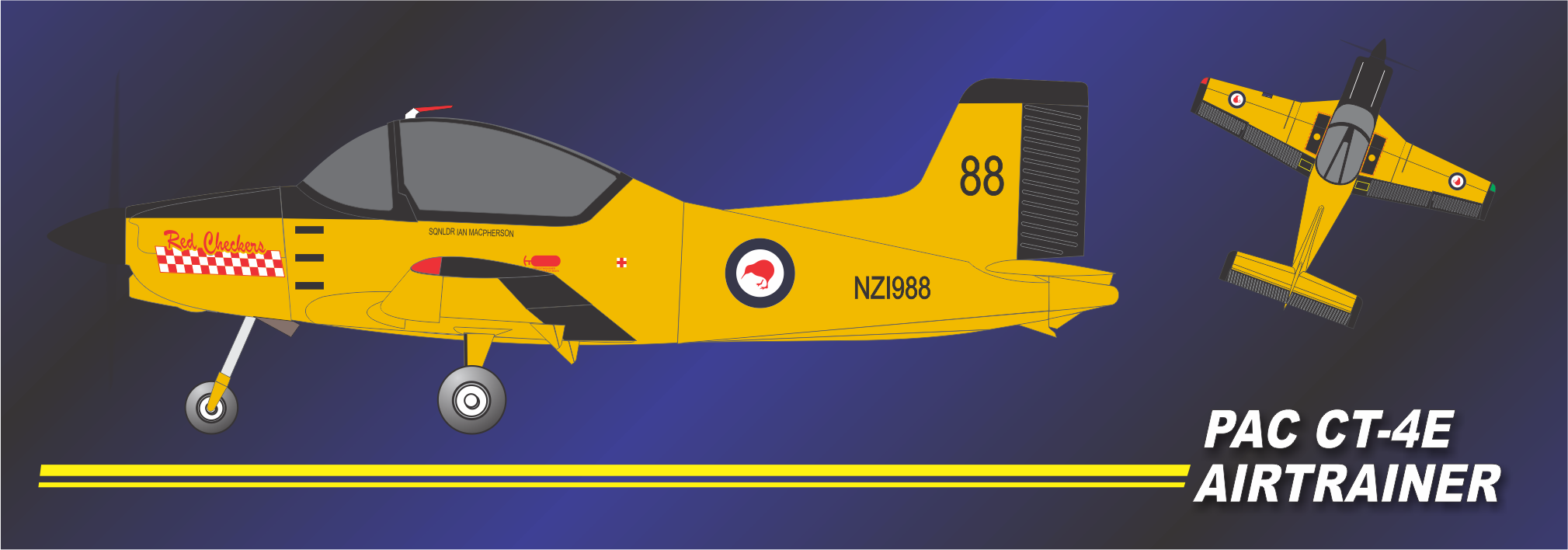

The CT-4 Airtrainer was a development of the Victa Airtourer in the early 1970’s.
The CT-4E is an aerobatic 2/3 seater with a 300 horsepower Lycoming engine, that flies like a fighter, sounds like a hot-rod and glides like a brick! The RNZAF and RSAF currently fly the E model, and have found the CT4 to be a great training platform, being strong, reliable and able to produce excellent pilots.
We are developing several versions of this aircraft, both small (after all the full-size aircraft is only 27 feet across!). One will be electric, and the other will be for nitro/gas. Although we haven’t started working on this design, it will likely be 1/4 or 1/3 scale.
Let us know if you are keen, and we can fast-track this design, or at the very least, let you know when it’s available.
Brief History of the CT4 design
The Pacific Aerospace Corporation (PAC) CT/4 Airtrainer is one of the most successful military training aircraft designed and built in Australasia. Although often regarded as a uniquely New Zealand aircraft, its origins lie in an Australian light aircraft designed during the late 1950s. The CT/4 evolved through several generations of increasingly capable aircraft while retaining the excellent handling characteristics that made it an outstanding ab-initio trainer.
Origins: The Airtourer (1957–1966)
The CT/4 lineage begins with Polish-born Australian aeronautical engineer Dr Henry Millicer, who designed a lightweight touring aircraft in response to a Royal Aero Club design competition in the late 1950s.
Timeline
- 1957–1958 – Dr Henry Millicer designs a two-seat all-metal touring aircraft.
- 31 March 1959 – Wooden prototype first flies.
- December 1961 – First all-metal prototype flies.
- 1962 – Production of the Victa Airtourer commences in Australia.
- 1961–1966 – Approximately 172 Airtourers are manufactured by Victa Aircraft before production ceases due to commercial pressures from imported aircraft.
The Airtourer quickly earned a reputation for:
- delightful handling
- aerobatic capability
- robust construction
- excellent visibility
These qualities would become fundamental to every later member of the CT/4 family.
The Aircruiser (1966–1971)
Victa recognised demand for a four-seat touring aircraft and enlarged the Airtourer into the Victa Aircruiser.
Major changes included:
- four-seat cabin
- larger wing
- increased fuel capacity
- strengthened fuselage
- non-aerobatic certification
Although only a prototype was completed, the stronger Aircruiser airframe would prove to be the ideal basis for a military trainer.
Production Moves to New Zealand
When Victa ceased aircraft manufacture, production rights to both the Airtourer and Aircruiser were purchased by Aero Engine Services Ltd (AESL) of Hamilton, New Zealand.
AESL resumed Airtourer production during the early 1970s, manufacturing approximately 80–87 aircraft. More importantly, management recognised that the Aircruiser’s stronger structure could be adapted into an aerobatic military trainer.
The RAAF Requirement (1971)
During 1971, the Royal Australian Air Force sought a replacement for its ageing CAC Winjeel basic trainers at RAAF Point Cook.
AESL’s chief designer P. W. C. Monk was tasked with developing a new aircraft based on the Aircruiser that could meet the demanding military specification.
Designing the CT/4
Although visually similar to the Aircruiser, the CT/4 was extensively redesigned.
Major engineering changes
- completely strengthened aerobatic structure
- four fuselage longerons changed from folded sheet sections to extrusions
- thicker skins in highly stressed areas
- strengthened wing carry-through structure
- redesigned engine installation
- larger 210 hp Continental IO-360 engine
- bubble canopy shaped as an aerofoil for improved visibility
- military instrumentation
- improved control harmony
The result was an aircraft stressed for +6/-3 g aerobatic operation while remaining relatively simple to maintain.
First Flight (1972)
The prototype CT/4 ZK-DGY (Serial 001) first flew on:
23 February 1972
Two prototypes were completed.
Flight testing immediately demonstrated:
- excellent spin characteristics
- precise controls
- exceptional visibility
- low operating costs
- forgiving stall behaviour
These qualities would become defining features of the aircraft.
Company Reorganisation (1973)
On 1 March 1973, AESL was reorganised as:
New Zealand Aerospace Industries Ltd (NZAI)
Production commenced shortly afterwards.
CT/4A Production (1973–1978)
The first production version was the CT/4A.
Powerplant
- Continental IO-360
- 210 hp
- Two-blade constant-speed propeller
Initial customers
Royal Thai Air Force
- 24 aircraft
Royal Australian Air Force
- 51 aircraft
The RAAF selected the CT/4 after competitive evaluation, replacing the Winjeel beginning in 1975. The aircraft quickly became affectionately known as the “Plastic Parrot”, despite being of all-metal construction, because of its bright green and yellow training scheme.
CT/4B Development
The 64th production aircraft introduced the CT/4B standard.
Changes were evolutionary rather than revolutionary and included:
- improved instrumentation
- detail systems improvements
- customer-specific equipment
Production included:
- 19 aircraft for the Royal New Zealand Air Force
- 6 aircraft for the Royal Thai Air Force
- 12 aircraft for Ansett/British Aerospace Flight Training at Tamworth, Australia.
The Rhodesian Embargo (Late 1970s)
One of the most unusual episodes in the programme involved an order for 14 CT/4Bs placed through Breco Trading Co., ostensibly for a Swiss flying club.
It was later discovered that the aircraft were intended for the Rhodesian Air Force, in breach of international sanctions. The New Zealand Government embargoed the completed aircraft, which remained in storage for approximately six years before eventually being sold to the RAAF.
The loss of the sale placed severe financial strain on NZAI and contributed to the company’s restructuring as Pacific Aerospace Corporation (PAC).
Production Hiatus (1982–1990)
By 1982, production had effectively ceased due to limited demand, although PAC continued to market the aircraft.
During this period, attention turned to developing a significantly improved trainer capable of competing internationally.
The CT/4C Turboprop (1991)
In an attempt to win a major USAF primary trainer competition, PAC developed the CT/4C.
Major modifications included:
- Allison 250 turboprop
- three-bladed propeller
- substantially higher performance
Only one prototype was built by converting a damaged RNZAF CT/4B. Although flight testing was successful, no production orders followed, and the aircraft was later converted back to CT/4B configuration.
Developed alongside the CT/4C, the CT/4E retained a piston engine but incorporated substantial redesign.
Key changes included:
- Lycoming AEIO-540 producing 300 hp
- three-blade Hartzell constant-speed propeller
- fuselage lengthened by approximately 100 mm
- wing attachment moved aft approximately 50 mm
- strengthened forward fuselage
- revised cooling system
- redesigned engine mount
- increased maximum weight
- significantly improved climb and aerobatic performance
Although initially unsuccessful in the USAF competition, the design later attracted military customers.
Return to Production (1998)
Production resumed with:
- 13 CT/4Es for the Royal New Zealand Air Force
- 16 CT/4Es for the Royal Thai Air Force
These aircraft replaced earlier CT/4A and CT/4B fleets.
Further aircraft were subsequently built for:
- Singapore Youth Flying Club (2)
- additional Royal Thai Air Force orders (bringing its CT/4E fleet to 24)
- a private Israeli owner
- PAC company demonstrator.
Operational Service
The CT/4 served as the primary trainer for several military organisations:
- Royal Australian Air Force (1975–1992)
- Australian Defence Force Basic Flying Training School, Tamworth (1993–2019 under contractor operation)
- Royal New Zealand Air Force (1978–2014)
- Royal Thai Air Force
- Singapore Youth Flying Club
Over its service life, the aircraft developed a reputation for:
- outstanding handling
- benign stall and spin characteristics
- excellent visibility
- economical operation
- structural durability
- suitability for both military and civilian training.
Production Summary
| Variant | Approximate production |
| Prototype CT/4 | 2 |
| CT/4A | 75 |
| CT/4B | 37 |
| CT/4C | 1 prototype |
| CT/4E | Approximately 40 |
| Total built | 154–155 aircraft (depending on whether converted prototypes are counted) |
Legacy
More than five decades after its first flight in 1972, the CT/4 remains one of the most successful aircraft ever designed and manufactured in New Zealand. Its evolution—from the Australian-designed Victa Airtourer, through the Aircruiser, to the highly refined CT/4E—demonstrates a thoughtful engineering philosophy: preserve excellent flying qualities while progressively improving strength, performance, and capability. That approach produced a trainer respected by instructors and students alike, with a service life spanning more than 40 years in front-line military training and a continuing presence in civilian and heritage aviation.
My personal CT4 experience
I’m happy to say that I spent over 850 hours at the controls of the CT4. It never gave me a moment’s concern or worry, and always brought me home.
After about 2 hours, the upright and non-adjustable seat position became uncomfortable, and in hot weather, that goldfish-bowl became VERY HOT! I recall walking across the apron in Tamworth for a sortie, and the outside temperature was 47 degrees C. My shoes were sticking to the soft asphalt. Upon climbing onto the wing and opening the canopy, we were hit in the face with oven-like temperatures. Checking the cockpit thermometer, it showed 63 degrees C…… We simply closed the canopy and walked back to the office! No point in persisting that day.
The CT4 is a great little aeroplane. Nimble and aerobatic, it encourages you to stretch your skills and push the envelope – not in a bad way, but to improve your skills. Great fun overall!
The E model was even more fun. Far more power and performance. When I flew the E, it was actually the prototype and not fully certified, so there were unfinished “refinements” to consider. The rudder trim was unable to fully cope with the new performance and you’d either run out of right rudder trim on climb, or left rudder trim on descent. However, the E was a far more exciting aeroplane in general and again – lots of fun.