
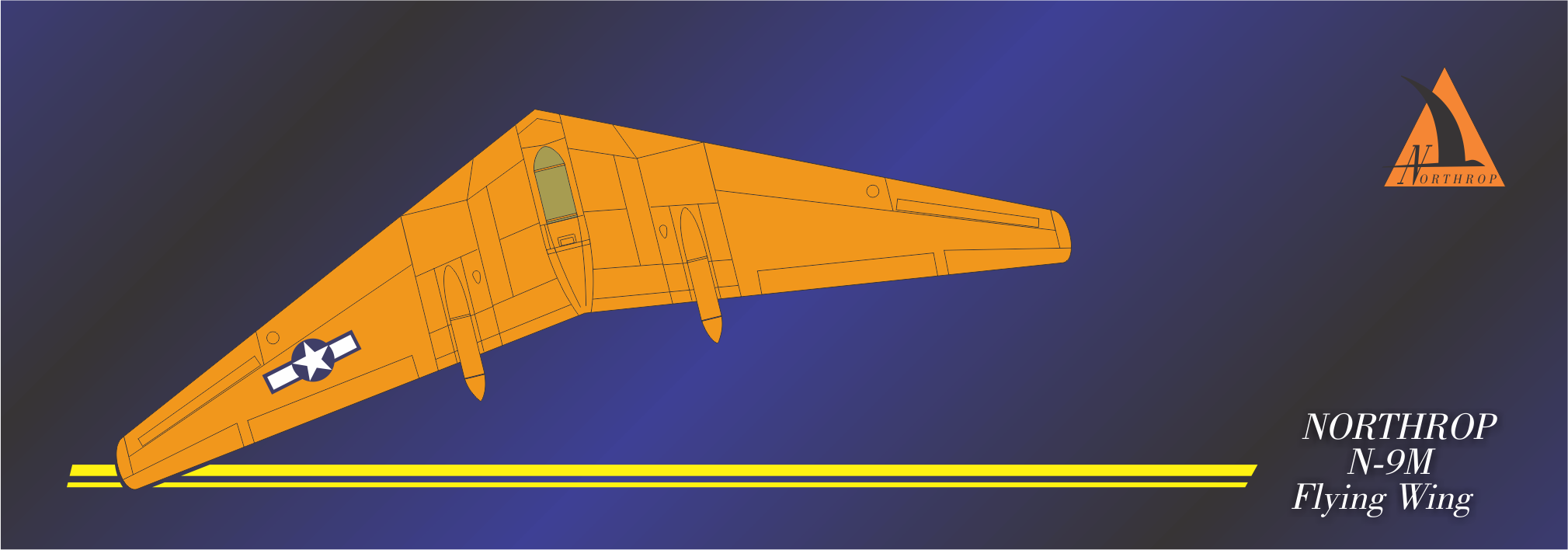

The Northrop N-9M was an approximate one-third scale, 60-ft wide, all-wing aircraft used for the development of the 172-ft wide Northrop XB-35 and YB-35 flying wing long-range, heavy bomber program. First flown in 1942, the N-9M (M for Model) was the third in a lineage of all-wing Northrop aircraft designs and was intended to prove the concept as practical and safe.
We have always been interested in the Northrop wings, and this one should look great in the air. It will be designed to use electric power, but will also be good as a PSS (unpowered slope soarer).
It will be a while before we have this one ready, but keep in touch if you’re interested in it.
Northrop N-9M – Design, Development, Production and Performance
The Northrop N-9M (often mistakenly referred to as the N9N) was an experimental flying-wing research aircraft developed by the Northrop Corporation during the Second World War. Designed by the pioneering aircraft engineer Jack Northrop, it served as a one-third-scale proof-of-concept aircraft for the enormous XB-35 Flying Wing strategic bomber. First flown on 27 December 1942, the N-9M demonstrated the feasibility of the tailless flying-wing concept and laid the technological foundation for later Northrop designs, culminating decades later in the B-2 Spirit stealth bomber. Only four aircraft were built.
Origins
Jack Northrop had believed since the late 1920s that the pure flying wing represented the most aerodynamically efficient aircraft configuration.
His reasoning was straightforward:
- eliminating the fuselage reduced parasite drag
- removing the tail reduced interference drag
- the entire aircraft generated lift
- structural weight could be reduced
- fuel could be carried throughout the wing
Northrop experimented with these concepts through several earlier aircraft, including the Northrop X-216H (1929) and the N-1M (1940), before the U.S. Army Air Forces became interested in applying the concept to a long-range bomber.
Development
On 30 October 1941, Northrop received a contract to develop the XB-35 Flying Wing heavy bomber.
Recognising the risks associated with such an unconventional aircraft, Northrop proposed a one-third-scale flying test aircraft to:
- investigate stability and control
- evaluate handling characteristics
- develop pilot operating techniques
- test aerodynamic refinements
- reduce risk before building the full-size bomber
The Army approved the proposal, and the aircraft received the designation:
N-9M (“Model”).
Originally only one aircraft was ordered, but this was expanded to four prototypes during the test programme.
Prototype Development
The four aircraft were:
- N-9M-1
- N-9M-2
- N-9M-A
- N-9M-B
The first prototype flew on 27 December 1942.
Tragically, on 19 May 1943, the first prototype crashed after entering an unrecoverable spin, killing test pilot Max Constant. Investigation identified a control reversal phenomenon that occurred at high angles of attack. The subsequent prototypes incorporated aerodynamic and control-system improvements to address these issues. The final N-9M-B also received more powerful and reliable engines.
Design Philosophy
Unlike conventional aircraft, the N-9M had:
- no fuselage
- no horizontal tailplane
- no vertical fin
Instead, virtually the entire aircraft was a wing.
The objectives were to demonstrate:
- aerodynamic efficiency
- structural simplicity
- high lift-to-drag ratio
- excellent long-range potential
- stable controllability without conventional tail surfaces
This represented one of the most radical aircraft designs of the 1940s.
Airframe Design
Flying Wing Configuration
The aircraft consisted almost entirely of a swept wing with a central crew nacelle blended into the wing.
Major features included:
- 60 ft (18.3 m) wingspan
- moderate wing sweep
- blended central cockpit
- twin pusher propellers
- elevon control surfaces
- split drag rudders near the wing tips
Without a conventional tail, pitch and roll were controlled by elevons, while yaw control was achieved using split drag rudders that opened on one wingtip to create differential drag. These concepts are still used on modern tailless aircraft such as the B-2 Spirit.
Construction
To conserve strategic materials during wartime, Northrop adopted a mixed-construction approach.
The aircraft featured:
- welded steel-tube centre section
- wooden internal wing structure
- laminated plywood wing skins
- fabric-covered control surfaces
This combination produced a lightweight yet sufficiently strong research aircraft.
Cockpit
The cockpit occupied the centre section of the wing.
Equipment included:
- conventional control column
- rudder pedals (operating the drag-rudder system)
- engine instruments
- flight instruments
- radio equipment
- test instrumentation
The final N-9M-B included a second observer seat for flight-test engineers during some evaluation flights.
Powerplant
Early Aircraft
The first three aircraft were powered by:
2 × Menasco C6S-4 Buccaneer
- inverted inline six-cylinder engines
- approximately 275 hp each
- driving pusher propellers
N-9M-B
The final prototype introduced:
2 × Franklin XO-540-7
- air-cooled engines
- 300 hp each
These engines offered improved reliability and performance over the Menasco units.
Aerodynamic Features
The N-9M incorporated numerous innovative features, including:
- swept flying wing
- reflex aerofoil sections for tailless stability
- geometric washout (wing twist)
- elevons
- split drag rudders
- pusher propellers to minimise airflow disturbance over the wing
These design elements allowed the aircraft to maintain longitudinal stability without a tailplane, although extensive flight testing was required to refine the control system.
Flight Testing
The N-9M programme investigated:
- longitudinal stability
- lateral stability
- yaw characteristics
- spin recovery
- stall behaviour
- structural loads
- pilot workload
The test programme revealed that while the flying wing offered exceptional aerodynamic efficiency, careful attention was needed to prevent departures from controlled flight at high angles of attack. The knowledge gained directly informed the design of the XB-35 and YB-35 bombers.
Production
Manufacturer
- Northrop Corporation
Production location
- Hawthorne, California, USA
Production timeline:
- 1942–1944
Aircraft completed:
| Variant | Quantity |
|---|---|
| N-9M-1 | 1 |
| N-9M-2 | 1 |
| N-9M-A | 1 |
| N-9M-B | 1 |
Total production: 4 aircraft.
Specifications (N-9M-B)
| Item | Specification |
|---|---|
| Crew | 1 (2 in some test configurations) |
| Length | 17 ft 9 in (5.41 m) |
| Wingspan | 60 ft 0 in (18.29 m) |
| Height | 6 ft 7 in (2.01 m) |
| Wing Area | 490 sq ft (45.5 m²) |
| Empty Weight | Approximately 5,890 lb (2,670 kg) |
| Maximum Take-off Weight | 6,326 lb (2,869 kg) |
| Engines | 2 × Franklin XO-540-7 |
| Power | 300 hp each |
Performance
| Performance | Value |
|---|---|
| Maximum Speed | 258 mph (415 km/h; 224 kt) |
| Cruise Speed | 208 mph (334 km/h; 180 kt) |
| Range | 500 mi (805 km; 435 NM) |
| Service Ceiling | 19,500–21,500 ft (5,940–6,550 m), depending on prototype |
| Power Loading | Approximately 10.5 lb/hp |
Flying Characteristics
The N-9M was unlike any conventional aircraft of its era. Test pilots reported:
- light control forces in normal flight
- efficient cruising performance
- excellent visibility
- smooth handling at moderate speeds
- sensitivity to angle of attack near the stall
The absence of a conventional tail required pilots to adapt to the aircraft’s unique control responses. Early testing identified challenges with stall recovery and directional stability, but successive modifications significantly improved handling and demonstrated that a large flying wing could be flown safely. These lessons proved invaluable for the XB-35 programme.
Legacy
Although only four N-9Ms were built, the programme became one of the most influential experimental aircraft projects in aviation history. The N-9M validated many of the aerodynamic and control concepts that enabled the development of the XB-35 and YB-35 flying-wing bombers. More importantly, it established a body of knowledge on tailless aircraft that would later contribute to the design philosophy behind the B-2 Spirit stealth bomber. One aircraft, N-9M-B, survived and was painstakingly restored to flying condition, delighting audiences at airshows until it was tragically lost in a fatal crash in 2019. Even so, the N-9M remains an enduring symbol of Jack Northrop’s visionary belief that the flying wing represented the most aerodynamically efficient form of aircraft.