
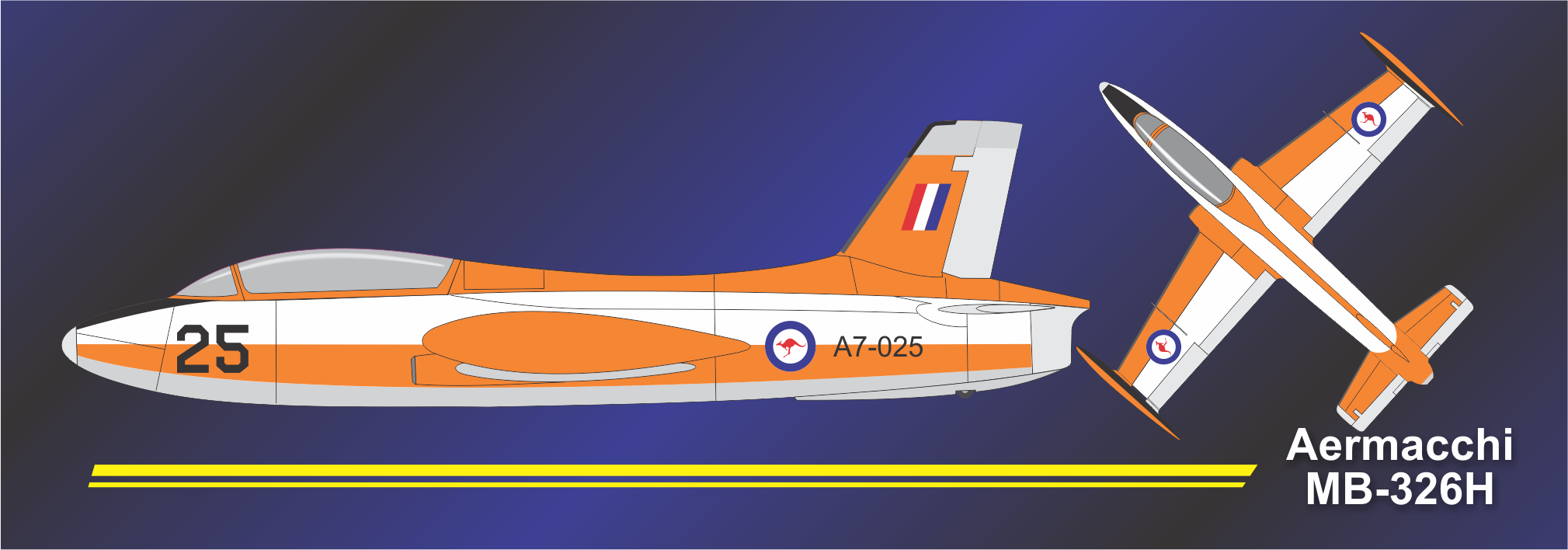
 The Aermacchi MB-326 is an early 60’s jet trainer, designed and built in Italy, and subsequently licence built in Australia, Brazil and South Africa. Several versions of the 326 were built, including a single-seat ground attack aircraft.
The Macchi was also used by several aerobatic teams, notably in Australia as the Telstars and Roulettes.
We’re designing two versions of this aircraft, one as a smaller EDF and the other as a 2-Metre turbine-powered model. Email us for information.
Aermacchi MB-326H – Design, Development, Production and Performance
The Aermacchi MB-326H was the Australian version of the Italian-designed Aermacchi MB-326 advanced jet trainer. Built under licence by the Commonwealth Aircraft Corporation (CAC) as the CA-30, it became one of the Royal Australian Air Force’s most successful training aircraft, serving from 1967 until 2001. It also equipped the Royal Australian Navy (RAN) and was the aircraft flown by the famous RAAF Roulettes aerobatic team from 1970 to 1989.
The MB-326H was designed as an “all-through” jet trainer, capable of taking pilots from their first jet flight through advanced and lead-in fighter training. It combined excellent handling, low operating costs, simple maintenance and light attack capability in a compact, reliable aircraft. Australia acquired 97 aircraft, making it one of the largest operators of the type.
Origins
During the early 1960s the RAAF sought a replacement for two ageing trainers:
- CAC Winjeel (basic training)
- de Havilland Vampire T.33 (advanced jet training)
Rather than continue operating both piston and jet trainers, the RAAF adopted the then-fashionable concept of all-through jet training, whereby pilots would complete nearly all flying training in a single aircraft type. In August 1965, the MB-326 was selected over several competing designs because of its low operating costs, excellent handling, modern systems and growth potential.
Italian Development
The MB-326 was designed by Ermanno Bazzocchi of Aermacchi during the mid-1950s.
The prototype first flew on:
10 December 1957
The aircraft rapidly gained international success because it offered:
- jet performance at turboprop operating costs
- excellent reliability
- forgiving handling
- simple maintenance
- fighter-like cockpit
More than 800 MB-326s of all variants were eventually produced worldwide, with licensed production in Australia, Brazil and South Africa.
Australian MB-326H Development
The Australian version incorporated numerous modifications specifically for local conditions.
Among the most significant were:
- enhanced internal corrosion protection
- rain-erosion coating on wing leading edges
- improved cockpit air conditioning
- modified cockpit lighting
- improved oxygen system
- sealed radio compartments against water ingress
- redesigned fuel and oil drain routing to reduce fire risk
- nosewheel shroud to reduce engine flame-outs on wet runways
These refinements produced one of the most capable and durable variants of the MB-326 family.
Design Philosophy
The MB-326H was designed to provide:
- economical jet training
- fighter-like handling
- forgiving low-speed characteristics
- excellent visibility
- simple maintenance
- secondary light attack capability
Unlike many jet trainers of its era, it was fully aerobatic and stressed for repeated training manoeuvres.
Airframe Design
Wing
The aircraft employs a cantilever low-mounted wing.
Characteristics include:
- all-metal stressed-skin construction
- slight leading-edge sweep
- large hydraulically operated flaps
- wingtip fuel tanks
- speed brake beneath the fuselage
The relatively thick wing section provided:
- excellent low-speed handling
- benign stall characteristics
- high roll rate
- good climb performance
The wingtip tanks increased fuel capacity while reducing wing bending loads.
Fuselage
The fuselage uses conventional aluminium semi-monocoque construction.
Features include:
- tandem seating
- pressurised cockpit
- ejection seats
- large equipment bays
- removable engine installation
The streamlined fuselage contributed to the aircraft’s impressive performance while remaining straightforward to manufacture and maintain.
Cockpit
The cockpit was advanced for the early 1960s.
Features included:
- tandem instructor/student seating
- Martin-Baker lightweight ejection seats
- full dual controls
- pressurised cockpit
- excellent all-round visibility
- comprehensive flight instrumentation
The cockpit layout closely resembled that of contemporary fighter aircraft, easing transition to frontline types.
Landing Gear
The MB-326H features a hydraulically operated retractable tricycle undercarriage.
Characteristics include:
- single-wheel main units
- steerable nosewheel
- hydraulic disc brakes
- wide-track geometry
The undercarriage was designed for frequent training operations and excellent ground handling.
Powerplant
The MB-326H is powered by one:
Rolls-Royce (Bristol Siddeley) Viper Mk 11 Mk.22
Specifications:
- single-spool axial-flow turbojet
- thrust: 11.12 kN (2,500 lbf)
Although the Viper had originally been developed as an expendable engine for target drones such as the Australian Jindivik, it was extensively redesigned into a durable, highly reliable powerplant. More than 5,500 Viper engines were ultimately produced for numerous aircraft types.
Aerodynamics
The MB-326 incorporated several advanced aerodynamic features:
- streamlined fuselage
- clean low-wing configuration
- tip-mounted fuel tanks
- T-tail
- fuselage-mounted speed brake
- carefully faired engine intakes
These features produced:
- low drag
- excellent manoeuvrability
- stable handling
- predictable stalls
- rapid acceleration
Structural Design
Construction consists primarily of:
- aluminium alloy semi-monocoque fuselage
- machined wing spars
- fail-safe structural philosophy
- removable access panels
- corrosion-resistant finishes
The aircraft proved extremely robust, although by the late 1990s widespread fatigue cracking eventually limited further service life.
Licensed Australian Production
The Australian manufacturing programme was one of the largest licence-production efforts undertaken by the Commonwealth Aircraft Corporation.
Production involved:
- Aermacchi (Italy)
- Commonwealth Aircraft Corporation (CAC) (prime contractor)
- Hawker de Havilland (HDH)
- numerous Australian subcontractors
Production progressed through several stages:
- first 12 aircraft imported complete from Italy
- next 18 assembled in Australia from imported kits
- remaining 67 manufactured largely in Australia as the CAC CA-30
Local content steadily increased:
- approximately 85% Australian content by the 31st airframe
- approximately 90% Australian content in Viper engine manufacture by the 81st engine
Aircraft assembly took place at Fishermans Bend, Victoria, while flight testing was conducted at Avalon.
Production
Manufacturer
- Aermacchi (Italy)
- Commonwealth Aircraft Corporation (Australia)
Australian designation:
CA-30
Production period:
- Italian production: 1961 onwards
- Australian production: 1967–1972
Australian procurement:
- 87 aircraft for the RAAF
- 10 aircraft for the RAN
Total Australian aircraft:
97
Operational Service
The MB-326H served with:
- Central Flying School
- No. 2 Flying Training School
- No. 25 Squadron
- No. 76 Squadron
- No. 77 Squadron
- No. 79 Squadron
- No. 2 Operational Conversion Unit
- No. 724 Squadron (RAN)
It was also the aircraft of the RAAF Roulettes from 1970 to 1989, becoming closely associated with Australian military aerobatic displays.
Armament
Although primarily a trainer, the MB-326H possessed a secondary ground-attack capability.
Typical stores included:
- two 7.62 mm Miniguns or optional 12.7 mm gun pods
- practice bombs
- rocket pods
- external fuel tanks
- light bombs
Maximum external stores approached 900 kg (2,000 lb) depending on configuration.
Specifications (MB-326H)
| Item | Specification |
|---|---|
| Crew | 2 |
| Length | 10.67 m (35 ft 0 in) |
| Wingspan | 10.57 m (34 ft 8 in) |
| Height | 3.71 m (12 ft 2 in) |
| Empty Weight | 2,236 kg (4,930 lb) |
| Maximum Take-off Weight | 4,300 kg (9,480 lb) |
| Engine | Rolls-Royce Viper 11 Mk.22 turbojet |
| Thrust | 11.12 kN (2,500 lbf) |
| Fuel | Internal plus wingtip tanks |
Performance
| Performance | Value |
|---|---|
| Maximum Speed | 806 km/h (501 mph; 435 kt) |
| Cruise Speed | Approximately 650 km/h (350 kt) |
| Initial Rate of Climb | 1,370 m/min (4,500 ft/min) |
| Service Ceiling | 13,411 m (44,000 ft) |
| Maximum Range | 1,512 km (940 mi) with large tip tanks |
| Take-off Run | Approximately 700 m (typical training weight) |
| Landing Speed | Approximately 175 km/h (95 kt) |
Flying Characteristics
The MB-326H earned an outstanding reputation among Australian military pilots for its:
- exceptionally balanced controls
- forgiving stall behaviour
- rapid roll response
- excellent visibility
- predictable aerobatic handling
- high reliability
Many instructors described it as a “delight to fly”, while its combination of stability and responsiveness made it ideal for formation flying, instrument training and lead-in fighter instruction. It was equally at home performing aerobatics with the Roulettes or preparing students for high-performance combat aircraft.
Retirement and Legacy
By the 1990s, advances in training philosophy and increasing airframe fatigue led to the MB-326H’s gradual replacement. The Pilatus PC-9/A assumed much of the basic and advanced training role, while the BAE Hawk 127 Lead-In Fighter took over lead-in fighter training. The final Australian MB-326H was retired in 2001 after 34 years of service.
The MB-326H remains one of Australia’s most significant military training aircraft. Its successful licence production strengthened the Australian aerospace industry, while its combination of Italian aerodynamic design and Australian engineering refinements produced an aircraft that trained several generations of RAAF and RAN pilots. Its long service life, exceptional reliability and graceful handling have ensured its place as one of the finest jet trainers of the Cold War era.