
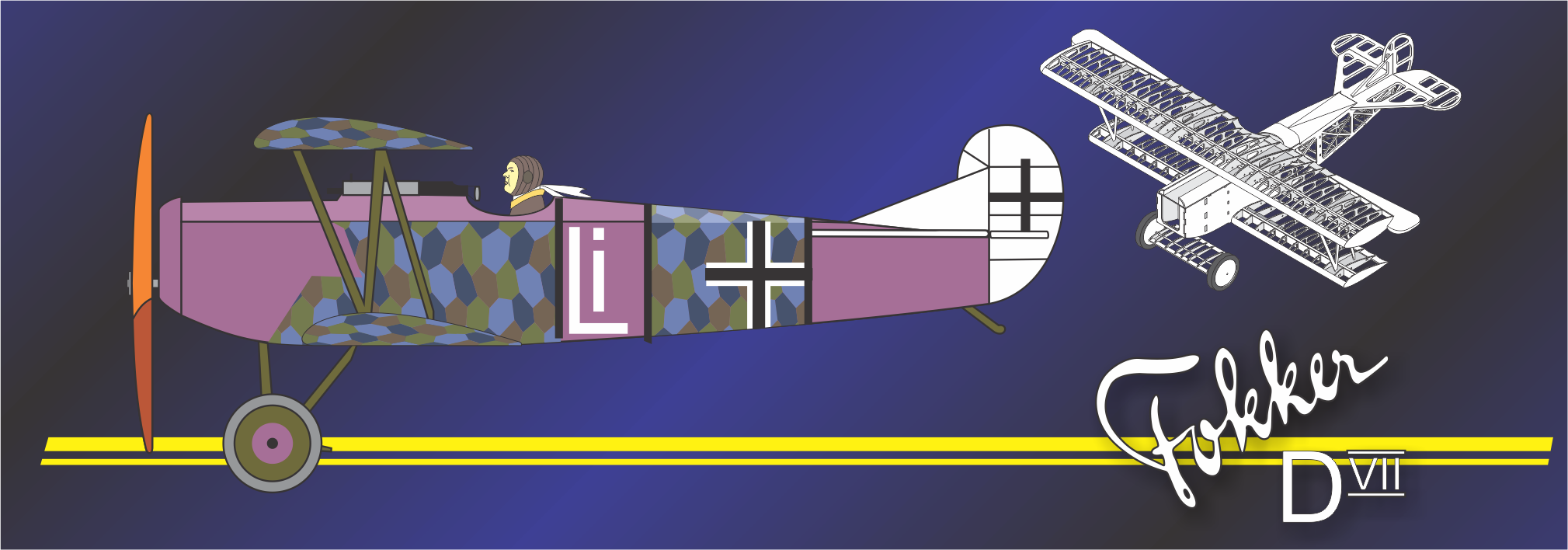

Having developed our 1/8 scale Combat Fokker, I was then asked to enlarge it to 1/5 scale, suitable for sport flying. After a short while, the design was completed and the results are seen here.
Specifications:-
Wingspan 1754mm 69.0 inches
Length 1407mm 55.4 inches
Channels – 4
Servos – 5


Fokker D.VII – Design, Development, Production and Performance
The Fokker D.VII is widely regarded as the finest German fighter aircraft of the First World War and one of the greatest fighter designs of the piston-engine era. Designed by Reinhold Platz for the Dutch-German Fokker Flugzeugwerke, the D.VII combined exceptional manoeuvrability, forgiving handling, high-altitude performance and structural strength. It was so highly regarded that the Armistice of 11 November 1918 specifically required Germany to surrender all surviving D.VIIs to the Allies—a distinction shared by no other aircraft type.
Origins
By late 1917, German fighter units were encountering increasingly capable Allied aircraft such as the Sopwith Camel, SE5a, and SPAD XIII. The German Air Service (Idflieg) therefore issued a requirement for a new single-seat fighter with:
- superior climb performance
- higher speed
- excellent manoeuvrability
- improved pilot visibility
- simple maintenance
- structural robustness
Chief designer Reinhold Platz, who had already designed the successful Fokker Dr.I triplane, developed a series of experimental aircraft designated the V-series.
Development
Fokker V.11
The aircraft that eventually became the D.VII began as the Fokker V.11.
It was entered into the First Fighter Competition held at Adlershof in January and February 1918, where Germany’s leading aircraft manufacturers competed to produce the next frontline fighter.
During the trials, Manfred von Richthofen (“The Red Baron”) flew the V.11 and recommended several changes, particularly moving the upper wing slightly aft to improve pilot visibility and handling. Platz incorporated these modifications before the aircraft was accepted for production as the D.VII.
Design Philosophy
Unlike many contemporary fighters that relied on light weight and agility alone, the D.VII was designed to provide:
- forgiving handling
- excellent climb
- outstanding controllability at low speeds
- structural strength
- high-altitude capability
- ease of manufacture
Its thick aerofoil allowed the aircraft to remain controllable at very high angles of attack, making it unusually resistant to spins and stalls.
Airframe Design
Wing
The D.VII employed a single-bay staggered biplane wing arrangement.
Features included:
- thick, high-lift aerofoil section
- wooden wing structure
- plywood leading edges
- fabric covering
- relatively little external bracing
Unlike many earlier fighters, the wing generated considerable lift without requiring excessive wire bracing, reducing drag and improving reliability.
The thick aerofoil produced remarkable low-speed characteristics. Pilots could often “hang” on the propeller during steep climbs while retaining effective control.
Fuselage
The fuselage represented one of the D.VII’s greatest engineering advances.
Construction consisted of:
- welded chrome-molybdenum steel tube framework
- fabric covering
- aluminium engine panels
- plywood cockpit decking
This steel-tube structure was considerably stronger than the wooden fuselages common in many contemporary fighters and greatly simplified repairs in frontline service.
Cockpit
The cockpit was relatively spacious for its time.
Equipment included:
- tachometer
- altimeter
- airspeed indicator
- compass
- fuel pressure gauge
- oil pressure gauge
- engine temperature gauges
- magneto switches
- throttle quadrant
- rudder pedals
- control column
Visibility over the nose was superior to many earlier German fighters due to the revised upper-wing position.
Landing Gear
The D.VII employed a simple fixed tailskid undercarriage comprising:
- steel-tube V-struts
- divided axle
- elastic shock cords
- ash tailskid
The wide-track landing gear contributed to good ground handling and reduced the likelihood of nose-overs compared with many contemporaries.
Powerplant
Several engines were fitted during production.
Mercedes D.IIIaü
The standard engine was the:
Mercedes D.IIIaü
- six-cylinder
- water-cooled inline
- approximately 180 hp
This powered most early-production aircraft.
BMW IIIa
The most desirable engine became the:
BMW IIIa
- six-cylinder water-cooled inline
- 185 hp
Although only slightly more powerful at sea level, the BMW IIIa incorporated a sophisticated high-compression carburetion system that maintained power much better at altitude. Aircraft fitted with this engine were designated D.VII(F), with the “F” honouring BMW engine designer Max Friz. These variants climbed faster, reached higher ceilings, and achieved slightly higher speeds than Mercedes-powered aircraft.
Armament
The standard armament consisted of:
- 2 × 7.92 mm LMG 08/15 Spandau synchronized machine guns
- approximately 500 rounds per gun
The guns fired through the propeller arc using a synchronisation mechanism, giving the pilot a concentrated and highly effective field of fire.
Aerodynamics
The D.VII introduced several advanced aerodynamic features:
- thick, high-lift aerofoil
- low-drag wing cellule
- carefully faired engine cowling
- streamlined fuselage
- balanced control surfaces
Unlike many fighters of the period, the D.VII remained controllable even near the stall, giving pilots confidence during tight manoeuvring combat.
Structural Design
The aircraft combined:
- welded steel-tube fuselage
- wooden wings
- fabric covering
- steel fittings
- aluminium engine cowlings
The steel-tube fuselage proved exceptionally durable and became influential in later aircraft design.
Production
Demand for the D.VII quickly exceeded Fokker’s manufacturing capacity.
Production was therefore shared between:
- Fokker Flugzeugwerke
- Albatros Flugzeugwerke
- Ostdeutsche Albatros Werke (OAW)
Each manufacturer incorporated minor differences in cowling shape, cooling louvres and finish, but all aircraft conformed to the same basic design.
By the Armistice in November 1918:
- more than 1,700 aircraft had been completed.
Production continued briefly in the Netherlands after the war, and aircraft were exported or sold to several countries including the Netherlands, Switzerland, Finland, Poland, Belgium, Sweden and the Soviet Union.
Specifications (BMW IIIa-powered D.VII(F))
| Item | Specification |
|---|---|
| Crew | 1 |
| Length | 6.95 m (22 ft 10 in) |
| Wingspan | 8.90 m (29 ft 2 in) |
| Height | 2.75 m (9 ft) |
| Wing Area | 20.5 m² (221 sq ft) |
| Empty Weight | 688 kg (1,517 lb) |
| Loaded Weight | 906 kg (1,998 lb) |
| Engine | BMW IIIa inline six-cylinder |
| Power | 185 hp |
| Armament | 2 × 7.92 mm Spandau machine guns |
Performance
| Performance | Value |
|---|---|
| Maximum Speed | 200 km/h (124 mph; 108 kt) at altitude |
| Cruise Speed | Approximately 160 km/h (86 kt) |
| Initial Rate of Climb | Approximately 9.5 m/s (1,870 ft/min) |
| Time to 5,000 m | About 17 minutes |
| Service Ceiling | 6,400 m (21,000 ft) |
| Endurance | Approximately 1.5–2 hours |
| Range | Approximately 300 km (186 mi) |
The Mercedes-powered aircraft were slightly slower, with a top speed of approximately 193 km/h (120 mph) and a lower service ceiling of about 18,000 ft.
Flying Characteristics
The D.VII earned universal praise from German pilots for its:
- exceptionally forgiving stall characteristics
- excellent climb performance
- light, harmonised controls
- high structural strength
- superb low-speed handling
- ability to “hang on the propeller” during steep climbs
Unlike the highly manoeuvrable but demanding Fokker Dr.I, the D.VII could be flown effectively by relatively inexperienced pilots while still allowing experienced aces to exploit its full combat potential. It was particularly effective in vertical manoeuvres, where its thick wing maintained lift at very low airspeeds.
Operational Service
The D.VII entered combat in May 1918 and rapidly equipped Germany’s elite fighter units, including Jagdgeschwader I. During the final months of the war it established air superiority in many sectors, with German pilots claiming hundreds of victories. Its combination of climb rate, altitude performance and forgiving handling made it a formidable opponent against Allied fighters such as the Sopwith Camel, SE5a and SPAD XIII.
Legacy
The Fokker D.VII is widely regarded by aviation historians as the pinnacle of First World War fighter development. Its welded steel-tube fuselage influenced many subsequent aircraft designs, while its thick aerofoil demonstrated the advantages of high-lift wings long before they became common. The aircraft’s exceptional reputation was such that Article IV of the Armistice required Germany to hand over all surviving D.VIIs, reflecting the Allies’ recognition of its military significance. Today, original examples are among the rarest and most prized First World War aircraft, with several meticulously restored airworthy reproductions continuing to demonstrate the outstanding flying qualities that made the D.VII a legend of military aviation.