
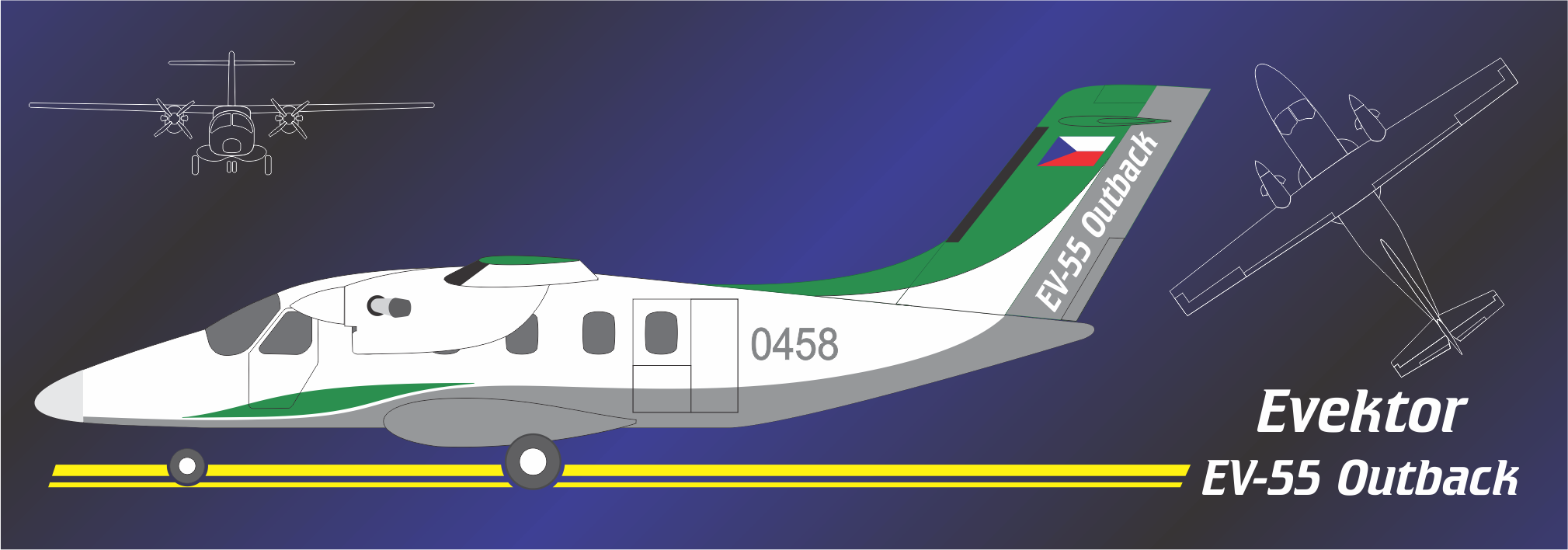

The EV-55 Outback is a brand new twin turboprop designed as a mini airliner and cargo aircraft. The website quotes it as a new generation twin, “able to replace any utility twin piston aircraft and offer a more reliable and powerful alternative to single engine utility turboprop aircraft. High productivity, operational reliability and inexpensive maintenance make this aircraft unique money maker for operators worldwide.”
Although not yet in production, the prototype looks great and as a model it should add a unique perspective for those wanting something a little different. We’re trying to keep the scale profile and wing on our model, so the plans may later be enlarged for a 2 – 2.4M scale model. However, initially, our intention is to produce a smaller version of around 1500mm.
Construction will be balsa and ply, and as the aircraft has an essentially square fuselage, it will be quite simple to build also. We’re expecting this to be a great model.
Evektor EV-55 Outback – Design, Development, Production and Performance
The Evektor EV-55 Outback is a Czech-designed twin-engine turboprop utility aircraft developed to fill the gap between the single-engine utility aircraft such as the Cessna 208 Caravan and larger commuter aircraft such as the Viking Twin Otter. Designed by Evektor-Aerotechnik of Kunovice, Czech Republic, the aircraft was intended to provide a versatile platform for regional airlines, cargo operators, air ambulance services and military users operating from short, unprepared airstrips.
Although the aircraft successfully completed its flight-test programme and two flying prototypes were built, the programme was suspended in March 2017 due to financial constraints before entering series production.
Origins
Development of the EV-55 began in 2004, when Evektor identified a niche for a modern, economical 9–14 seat utility aircraft capable of operating in remote regions where infrastructure was limited.
The principal design goals were:
- Short Take-Off and Landing (STOL) capability
- operation from gravel, grass and unprepared runways
- low operating costs
- modern avionics
- rapid reconfiguration between passenger and cargo roles
- excellent hot-and-high performance
Unlike many commuter aircraft derived from earlier designs, the EV-55 was conceived from the outset as a purpose-built utility aircraft.
Development
Following several years of aerodynamic design and structural testing, the first flying prototype was completed at Kunovice.
Development milestones
| Year | Milestone |
|---|---|
| 2004 | Project announced |
| 2007 | Detailed design completed |
| 2010 | Ground testing commenced |
| 24 June 2011 | First flight of prototype EV-55M |
| 2012–2016 | Flight-test and certification programme |
| March 2017 | Programme suspended |
Two flying prototypes and one static-test airframe were completed. Despite encouraging flight-test results, insufficient investment prevented certification and production.
Design Philosophy
The EV-55 was designed to combine:
- the payload of a commuter aircraft
- the operating economy of a light turboprop
- excellent STOL performance
- modern systems
- rugged field capability
Particular emphasis was placed on flexibility, allowing rapid conversion between:
- passenger transport
- freight
- air ambulance
- parachute operations
- surveillance
- military utility missions
Airframe Design
Wing
The EV-55 features a high-mounted cantilever wing, chosen to maximise propeller clearance and improve operation from rough airstrips.
Characteristics include:
- all-metal stressed-skin construction
- high aspect ratio
- large Fowler flaps
- full-span leading-edge devices
- integral fuel tanks
The wing provides:
- low stall speeds
- excellent climb performance
- short-field capability
- stable handling at low speed
Fuselage
The fuselage is an all-metal semi-monocoque structure with a large constant-section cabin.
Features include:
- flat cabin floor
- rear cargo door
- quick-change interior
- large baggage volume
- corrosion-resistant construction
The cabin was specifically designed for rapid conversion between passenger and cargo configurations.
Cabin
The standard passenger layout accommodates:
- 9 passengers under many regulatory frameworks (allowing single-pilot commercial operation in some jurisdictions)
- up to 14 occupants in higher-density configurations, depending on certification requirements
Cabin features include:
- large windows
- individual passenger doors
- sound insulation
- environmental control system
- removable seating
Medical evacuation versions were planned with stretcher installations and attendant seating.
Cockpit
The EV-55 was equipped with a modern glass cockpit from the outset.
Features included:
- dual large-format LCD displays
- integrated flight management system
- digital engine monitoring
- weather radar
- GPS navigation
- digital autopilot
- optional synthetic vision
The avionics suite was intended to reduce pilot workload while supporting both civil and military operations.
Landing Gear
The aircraft employs a fixed tricycle landing gear, reflecting its utility role.
Advantages include:
- reduced maintenance
- lower operating costs
- improved reliability
- excellent rough-field capability
- simplified operation in remote regions
The main landing gear is mounted on robust fuselage structures designed to absorb repeated operations from unimproved strips.
Powerplant
The EV-55 is powered by two:
Pratt & Whitney Canada PT6A-21
Each engine develops approximately:
550 shaft horsepower (410 kW)
Each engine drives a three-bladed constant-speed propeller.
The PT6A-21 was selected because of its:
- exceptional worldwide reliability
- low maintenance requirements
- excellent short-field performance
- strong hot-and-high capability
- global service support
Aerodynamics
Several aerodynamic features distinguish the EV-55:
- high-mounted wing
- large-span Fowler flaps
- carefully faired engine nacelles
- tall vertical stabiliser
- high-lift wing section
- streamlined fuselage
These features were optimised to provide:
- excellent STOL capability
- stable low-speed handling
- efficient cruise performance
- good single-engine controllability
Structural Design
The structure is designed for intensive utility operations.
Construction consists primarily of:
- aluminium alloy semi-monocoque fuselage
- machined wing spars
- reinforced landing gear attachments
- corrosion-resistant materials
- easily removable inspection panels
The aircraft was intended for high utilisation rates typical of regional airline and government operators.
Production
Manufacturer
- Evektor-Aerotechnik
Location
- Kunovice, Czech Republic
Production status
- Development suspended
Aircraft completed:
- 2 flying prototypes
- 1 static-test airframe
Despite significant international interest, no production aircraft were delivered before development was halted in 2017.
Proposed Variants
Planned versions included:
- passenger commuter
- cargo freighter
- air ambulance
- military utility transport
- maritime patrol
- surveillance aircraft
- parachute jump aircraft
These variants were intended to broaden the aircraft’s appeal across both civil and government markets.
Specifications
| Item | Specification |
|---|---|
| Crew | 1–2 |
| Passengers | 9–14 (configuration dependent) |
| Length | 14.35 m (47 ft 1 in) |
| Wingspan | 16.10 m (52 ft 10 in) |
| Height | 5.00 m (16 ft 5 in) |
| Maximum Take-off Weight | 4,600 kg (10,141 lb) |
| Empty Weight | Approximately 2,600 kg (5,732 lb) |
| Useful Load | Approximately 2,000 kg (4,409 lb) |
| Engines | 2 × Pratt & Whitney Canada PT6A-21 |
| Power | 550 shp each |
| Propellers | Three-blade constant-speed |
Performance
Because the programme did not reach certification, some performance figures remained projected rather than certified. The design targets and flight-test results included:
| Performance | Value |
|---|---|
| Cruise Speed | 170–220 kt |
| Stall Speed | Approximately 61 kt (target) |
| Service Ceiling | 25,000 ft |
| Range | Approximately 1,000–1,200 NM (mission dependent) |
| Take-off Distance | Approximately 500–600 m (STOL target) |
| Landing Distance | Approximately 500 m |
| Payload | Up to 2,000 kg |
Operational Characteristics
The EV-55 was designed to offer:
- excellent short-field performance
- simple handling characteristics
- low operating costs
- high payload flexibility
- rapid role conversion
- strong single-engine capability
- operation from remote and unimproved airstrips
Its combination of twin-engine safety, PT6 reliability and STOL capability made it particularly attractive for regional operators in Africa, South America, Australia and Southeast Asia.
Legacy
Although the EV-55 Outback never entered commercial production, it represented one of the most ambitious European utility-aircraft programmes of the 21st century. Its clean-sheet design combined modern avionics, efficient Pratt & Whitney PT6A turboprops, a spacious modular cabin and genuine STOL performance in an aircraft aimed squarely at underserved regional markets. The suspension of the programme in 2017 was primarily a consequence of funding and certification challenges rather than deficiencies in the design itself. As a result, the EV-55 remains an example of a technically promising aircraft that demonstrated strong capability in testing but never reached serial production.