

What do you get when you produce a light jet in Switzerland? For a start, you’ll get the Swiss Army Knife of the aviation world, able to go anywhere and do anything.
Pilatus are marketing it as the “move-up” solution for PC-12 owners who want to go faster and higher, but still have the same reliable, utilitarian functionality they’ve come to expect. Not only does it look great, but it will also flies beautifully, and pilots and owners alike are loving it.
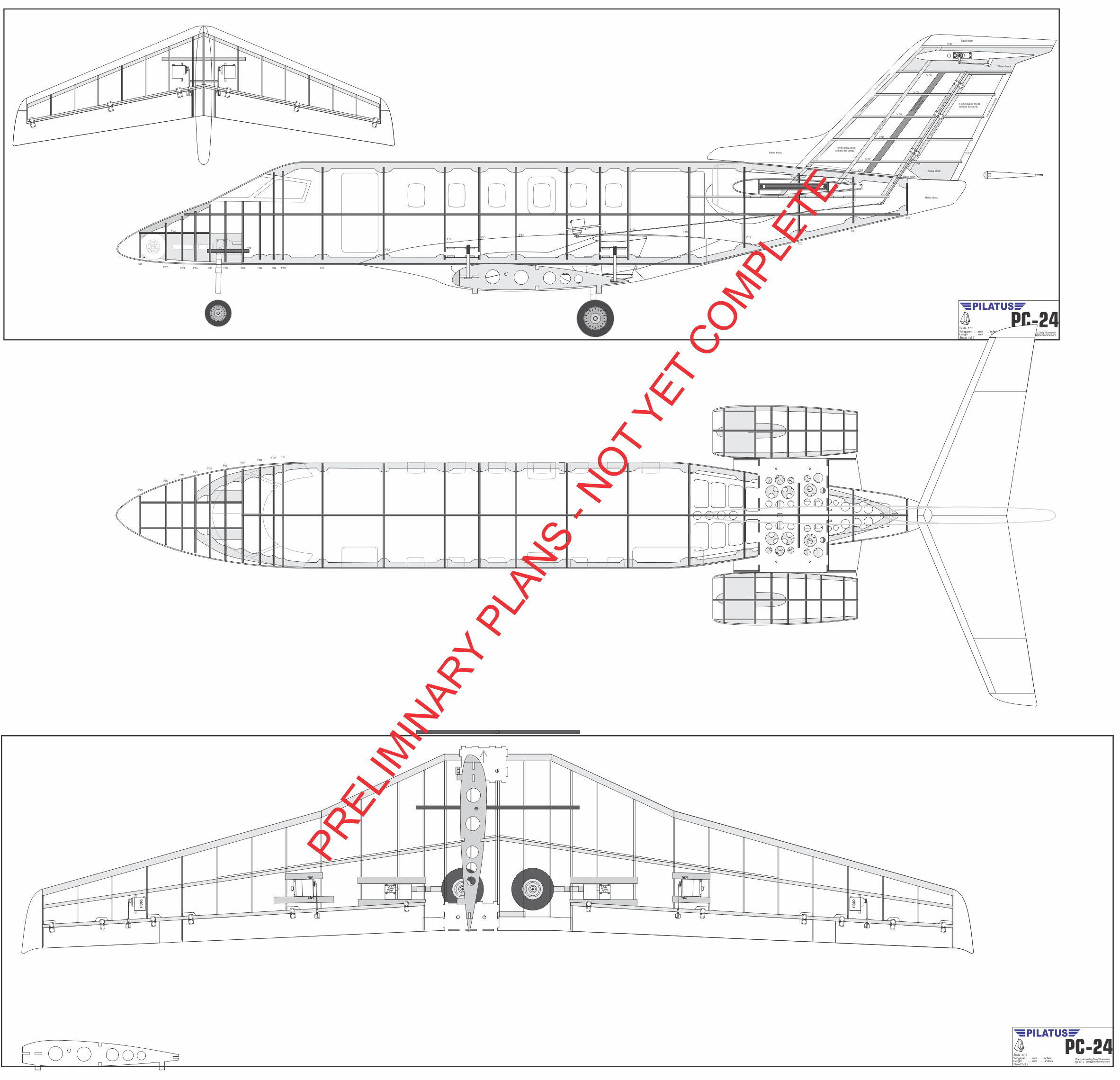
The plans cover four sheets, and are currently available for twin 70mm EDF units, in 1/10 scale. Here are the dimensions:-
Wingspan – 1700mm
Length – 1680mm
Channels – 6
Servos – 7

Pilatus PC-24 – Design, Development, Production and Performance
The Pilatus PC-24 is a Swiss twin-engine light business jet developed and manufactured by Pilatus Aircraft Ltd. of Stans, Switzerland. Introduced as the world’s first “Super Versatile Jet”, the PC-24 was designed to combine the speed and comfort of a modern business jet with the short-field capability, ruggedness and operational flexibility normally associated with turboprop utility aircraft such as Pilatus’ own PC-12.
The aircraft is capable of operating from paved, grass, gravel, dirt and snow runways, giving it access to thousands of airfields unavailable to conventional business jets. It also introduced a unique feature for its class: a large standard cargo door, allowing rapid conversion between executive, commuter, cargo and special-mission configurations.
Origins and Design Requirements
Following the success of the Pilatus PC-12, Pilatus identified a market requirement for a larger aircraft that retained the PC-12’s versatility while offering:
- jet performance
- increased passenger capacity
- higher altitude capability
- greater range
- improved comfort
- short and rough-field capability
The PC-24 project was formally announced in 2008 at the European Business Aviation Convention & Exhibition (EBACE).
The design objectives were unusual for a business jet:
- operate from short runways
- operate from unprepared surfaces
- carry bulky freight
- provide executive-class comfort
- require minimal ground support
- retain single-pilot capability
Rather than compete directly with conventional light jets such as the Cessna Citation series or Embraer Phenom, Pilatus created an entirely new category between a business jet and a utility aircraft.
Development History
Major milestones:
| Event | Date |
|---|---|
| Programme announced | 2008 |
| Prototype first flight | 11 May 2015 |
| First production aircraft flown | 2017 |
| FAA/EASA certification | December 2017 |
| Entry into service | 2018 |
The first prototype, P01 (HB-VXA), flew from Buochs Airport, Switzerland, beginning an extensive flight-test programme.
The certification campaign involved three prototype aircraft:
- P01 – aerodynamic and systems testing
- P02 – avionics and systems development
- P03 – production-standard aircraft and cabin evaluation
Design Philosophy
The PC-24 was designed around three core principles:
1. Jet Performance
Providing:
- high-speed cruise
- high-altitude operation
- long-range capability
2. Universal Access
Allowing operation from:
- short runways
- regional airports
- remote airfields
- unsealed surfaces
3. Multi-Mission Capability
Allowing rapid conversion between:
- corporate transport
- passenger charter
- air ambulance
- government transport
- surveillance
- cargo operations
Airframe Design
Overall Configuration
The PC-24 is a:
- low-wing
- twin-engine
- pressurised
- retractable landing gear
- T-tail business jet
The configuration resembles larger business jets but incorporates many utility-aircraft features.
Wing Design
The aircraft uses a:
low-mounted swept wing
Features include:
- supercritical aerofoil design
- composite control surfaces
- large Fowler flaps
- spoiler panels
- winglets
The wing was optimised for both:
- efficient high-speed cruise
- low-speed STOL operation
The large flaps and high-lift devices allow the aircraft to approach at speeds significantly lower than many comparable jets.
Fuselage Design
The fuselage is constructed primarily from aluminium alloys with composite components.
Key features:
- circular pressurised cabin
- large cabin cross-section
- flat cabin floor
- large aft baggage area
- full-height cabin access
The most distinctive feature is the:
Large Cargo Door
Dimensions:
- approximately 1.25 m × 1.30 m
This allows loading of:
- pallets
- medical equipment
- bulky cargo
- special mission equipment
It was the first business jet in its category to offer such a large standard cargo door.
Cabin Design
The PC-24 cabin is among the largest in the light-jet category.
Typical configurations include:
- six-seat executive layout
- eight-seat double club arrangement
- commuter configuration for up to ten passengers
- air ambulance interiors
Cabin features:
- flat floor
- large windows
- enclosed lavatory
- galley options
- configurable seating
- baggage access during flight
Cockpit and Avionics
The PC-24 uses the:
Honeywell Advanced Cockpit Environment (ACE)
Features include:
- four large flat-panel displays
- integrated flight management system
- synthetic vision
- weather radar
- traffic avoidance system
- automatic flight guidance
- dual flight management systems
- LPV approach capability
The latest PC-24 aircraft include:
- touchscreen controllers
- autothrottle
- enhanced automation
- improved navigation capability
Landing Gear
A major design feature is the rugged landing gear system.
Features:
- retractable tricycle configuration
- dual-wheel main landing gear
- trailing-link geometry
- large low-pressure tyres
- powerful braking system
The aircraft can be equipped with a gravel kit for operations from:
- grass
- gravel
- dirt
- snow surfaces
Powerplant
The PC-24 is powered by:
2 × Williams International FJ44-4A Turbofan Engines
Specifications:
| Parameter | Value |
|---|---|
| Engine type | Two-spool turbofan |
| Thrust per engine | 3,420 lbf (15.2 kN) |
| Total thrust | 6,840 lbf |
The FJ44 was selected because of:
- high reliability
- low fuel consumption
- compact size
- excellent hot-and-high performance
- low maintenance requirements
Aerodynamic Design Features
The PC-24 incorporates several features unusual for a business jet:
High-lift wing
Provides:
- low approach speeds
- short landing distances
- excellent low-speed control
Large flaps
Enable:
- steep approaches
- reduced landing speeds
- short runway performance
Robust structure
Allows:
- rough-field operation
- repeated short-field cycles
- higher operational flexibility
Structural Design
The aircraft uses:
- aluminium alloy primary structure
- composite fairings
- composite control surfaces
- advanced corrosion protection
The structure was designed for:
- high utilisation rates
- frequent airport cycles
- demanding operational environments
Production
Manufacturer:
Pilatus Aircraft Ltd.
Production location:
Stans, Switzerland
Production began:
2017
The PC-24 remains in production.
The aircraft is assembled at Pilatus’ main facility at Stans, with components supplied from a global aerospace manufacturing network.
Production Numbers
By the mid-2020s:
- more than 200 aircraft had been delivered
- operators include corporate, government, medical and special-mission users
Major operators include:
- Royal Flying Doctor Service of Australia
- Swiss Air Force
- U.S. government agencies
- corporate flight departments worldwide
Variants
PC-24
The original production model.
PC-24 NG / Enhanced PC-24
Introduced improvements including:
- increased payload capability
- improved range
- cabin refinements
- avionics upgrades
The 2024 enhancement package increased payload capability by approximately 272 kg (600 lb) and increased maximum range with six passengers to approximately 2,000 nautical miles.
Specifications (Current PC-24)
| Item | Specification |
|---|---|
| Crew | 1–2 |
| Passengers | Up to 10 |
| Length | 16.81 m (55 ft 2 in) |
| Wingspan | 17.00 m (55 ft 9 in) |
| Height | 5.35 m (17 ft 7 in) |
| Maximum Take-off Weight | Approximately 8,005 kg (17,650 lb) |
| Engines | 2 × Williams FJ44-4A |
| Thrust | 3,420 lbf each |
Performance
| Performance | Value |
|---|---|
| Maximum Cruise Speed | 440 kt TAS |
| Maximum Altitude | 45,000 ft |
| Maximum Range (4 passengers) | Approximately 2,040 NM |
| Maximum Range (6 passengers) | Approximately 2,000 NM |
| Initial Rate of Climb | Approximately 3,960 ft/min |
| Take-off Distance (50 ft obstacle) | Approximately 3,090 ft |
| Landing Distance (50 ft obstacle) | Approximately 2,410 ft |
| Stall Speed (landing configuration) | Approximately 83 kt |
Operational Roles
The PC-24 has been adapted for:
Corporate Transport
- executive travel
- charter operations
- fractional ownership
Medical Evacuation
Advantages:
- large cabin
- cargo door
- rapid patient loading
- long range
Government and Military
Roles include:
- VIP transport
- liaison
- communications
- surveillance
Special Missions
Potential applications:
- maritime patrol
- border surveillance
- electronic monitoring
Flying Characteristics
Pilots generally regard the PC-24 as having:
- excellent visibility
- stable instrument handling
- strong climb performance
- predictable low-speed behaviour
- responsive controls
- forgiving landing characteristics
The aircraft’s combination of jet performance and turboprop-like runway capability is its defining characteristic.
Legacy
The Pilatus PC-24 represents a significant innovation in business aviation. Rather than simply producing another light business jet, Pilatus created a new class of aircraft: a high-performance jet capable of operating in environments normally reserved for utility aircraft.
Its combination of:
- Mach 0.74-class cruise capability
- 45,000 ft operating altitude
- large cargo capacity
- short-field performance
- rough-runway capability
- flexible cabin configuration
has made it one of the most distinctive business aircraft of the modern era. Like the PC-12 before it, the PC-24 demonstrates Pilatus’ design philosophy of creating aircraft that prioritise operational capability over conventional market categories.